
The Sovereign Economy
Why Your Next Payment Processor Should Be You!
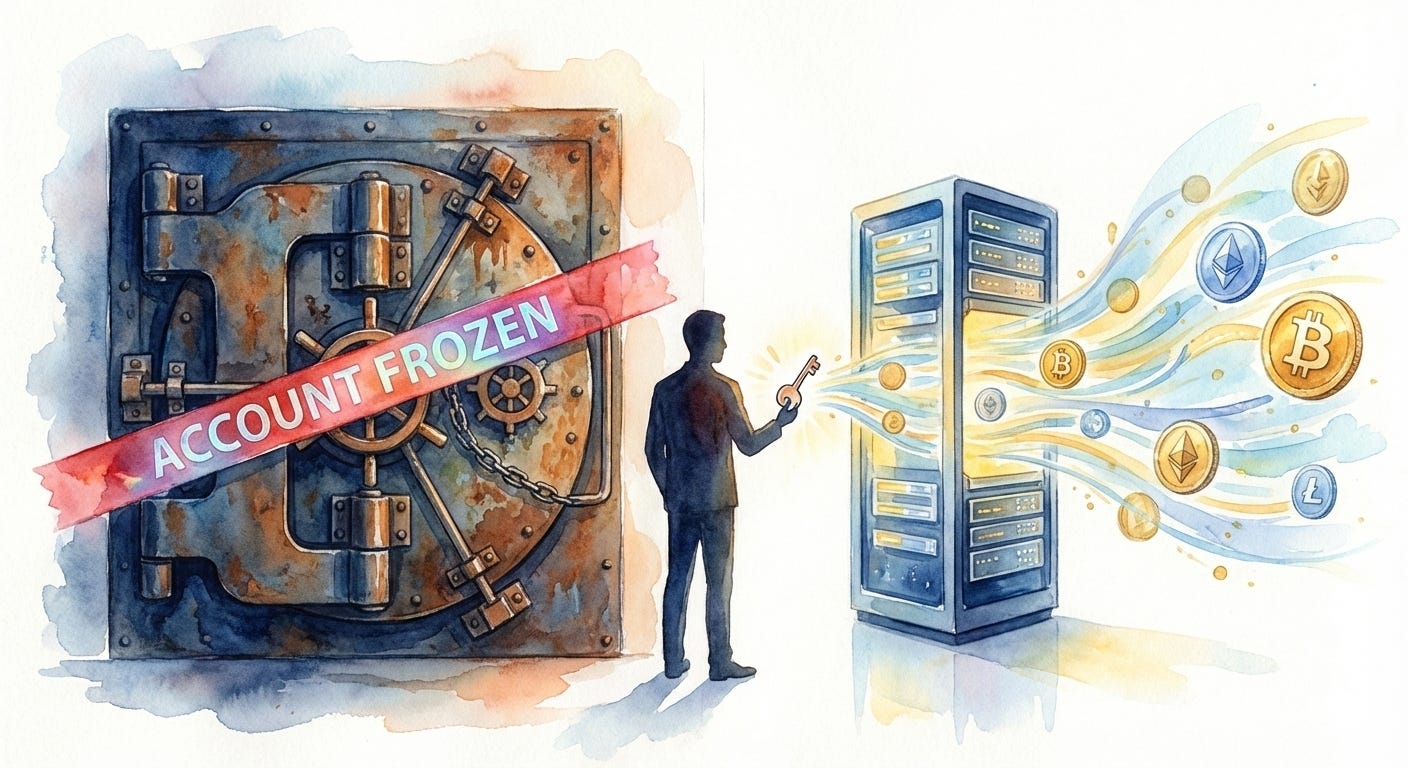
Imagine waking up to an email from your payment provider: “We have noticed unusual activity on your account. Your funds have been frozen for 180 days pending review.”
For millions of merchants, creators, and founders, this isn’t a hypothetical nightmare—it’s a reality of the “rented” economy. In the traditional financial system, you don’t own your money; you have a permissioned claim to it, revocable at any moment by an algorithm or a risk officer you will never meet.
But a quiet revolution is dismantling this system. We are witnessing the rise of permissionless commerce, where value moves as freely as email, and ownership is absolute.
This is why the future of payments isn’t about finding a better bank—it’s about becoming one.
The Great Flippening: The $27 Trillion Signal
If you still think stablecoins are just “crypto casino chips,” you are looking at the wrong data. The market has already voted, and the results are staggering.
In 2024, stablecoins (digital dollars like USDC and USDT) processed an estimated $18.4 trillion to $27.6 trillion in transaction volume. Compare that to the giants of the old world:
Visa: ~$15.7 trillion
Mastercard: ~$9.8 trillion
The “flippening” has happened. Capital is flowing away from the slow, expensive, and gated rails of legacy banking toward the instant, 24/7 settlement of public blockchains. Why? Sending $100,000 internationally via SWIFT takes days and costs a fortune in fees. Doing it via stablecoins takes seconds and costs pennies.
The “Rented” Economy vs. The “Owned” Economy
The core problem with traditional payment processors (like PayPal, Stripe, or Square) isn’t just fees; it’s control.
These platforms operate within “Walled Gardens.” They are under immense regulatory pressure to police their networks, leading to a “guilty until proven innocent” approach.
The 180-Day Freeze: Rapid growth is often flagged as “risk.” If your business scales too fast, algorithms may lock your working capital for six months to cover potential chargebacks.
Financial Censorship: Perfectly legal businesses in industries deemed “high risk”—such as independent media, supplements, or adult entertainment—can be de-platformed overnight. This phenomenon, often called “Operation Chokepoint 2.0,” effectively cuts legitimate businesses off from the economy.
In a digital age, if you can’t process payments, you don’t have a business. You have a hobby that someone else allows you to monetize.
The Solution: Permissionless Commerce
The antidote to this vulnerability is permissionless commerce.
This model fundamentally shifts the power dynamic. In the legacy system, you ask, “May I please process this payment?” In a permissionless system, you assert, “I am processing this payment.”
How It Works: The Self-Hosted Gateway
To achieve true sovereignty, merchants are turning to self-hosted payment gateways. Instead of relying on a third party to collect funds and (hopefully) pay them out, merchants run software on their own servers that connects directly to the blockchain.
Direct P2P Settlement: The customer sends funds directly to your wallet. No middleman touches the money.
Censorship Resistance: Because you hold the private keys, no one can freeze your funds or block a transaction.
Zero Middleman Fees: Traditional processors charge ~2.9% per transaction. Self-hosted solutions often cost 0% in processing fees—you only pay the network gas fee (often fractions of a cent).
This is the digital equivalent of accepting cash. It is private, final, and owned entirely by you.
The Next Frontier: Agentic Commerce
If you think this technology is just for human shoppers, think bigger. We are entering the era of Agentic Commerce, where AI agents will negotiate and transact on our behalf.
Imagine your AI assistant booking a flight, paying a subscription, or buying data for a research project. The legacy banking system is incompatible with this future:
No ID: AI agents cannot provide a driver’s license for KYC (Know Your Customer) checks.
Micro-transactions: Agents will likely pay for data in real-time streams (e.g., $0.0001 per second). Visa’s fixed fees make this impossible.
Stablecoins are the native currency of AI. They allow for programmable money—payments that execute automatically when code conditions are met. New standards like x402 (Payment Required) are being built to allow AI agents to browse the web and pay for resources autonomously, creating a machine-to-machine economy that operates entirely on permissionless rails.
Conclusion: Rent vs. Own
The economy is bifurcating. On one side are the legacy rails: convenient but custodial, surveilled, and subject to arbitrary shutdowns. On the other is the open economy: borderless, private, and owned by the user.
The data shows the world is moving toward the latter. For merchants, creators, and developers, the question is no longer “Should I accept crypto?” It is “Can I afford to rely on a system that can turn off my revenue switch?”
The technology to own your financial destiny exists today. The future of payments isn’t just digital; it’s sovereign.